
By Maj. Riley M. Kramer
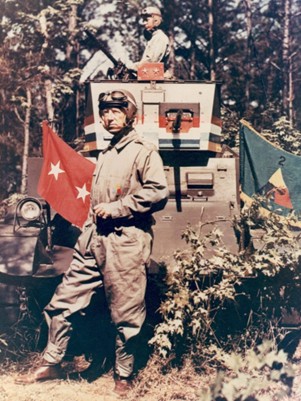
Gen. George Patton, perhaps the most iconic American commander of the twentieth century, destroyed Nazi formations in North Africa, Sicily, and the Ardennes Forest. We all know this story; but before the fury of “Old Blood and Guts” was felt on World War II battlefields, he bolted through East Texas alongside his newly formed 2nd Armored Division, symbolizing the U.S. Army’s modernizing force and Patton’s surging leadership.
His dramatic dash through the Lone Star State reminds us of the crucial but forgotten peacetime training operations called the “Louisiana Maneuvers” of September 1941, only a few months before the nation entered the war after Japan attacked Pearl Harbor on December 7, 1941.
The Texas-Louisiana borderlands represent a site of forgotten American military triumph of the Second World War. The fact that this triumph occurred before real bullets started flying toward American troops is precisely my point. Peacetime training is crucial, and the Louisiana Maneuvers serve as an excellent example of such preparation. Despite that, the massive mobilization efforts during World War II remain a footnote in the minds of many who celebrate Allied victories, such as the Normandy beach landings on D-Day and the freezing struggle of the Battle of the Bulge. But before boasting about the famous victories, we should understand how we got there.
The World in September 1941
The Louisiana Maneuvers commenced two years after Germany’s brazen invasion of Poland on September 1, 1939, igniting the Second World War. While this alerted Americans to the threat of widespread war, Germany’s swift victory over France in the summer of 1940 prompted the United States to actively prepare for war. As European powers collapsed, Japan aggressively pursued control of the Pacific, directly threatening U.S. territories, bases, and allies.
By September 1941, much of Europe and North Africa were under Axis control. The Nazis seized Kyiv early that summer as part of its invasion of the Soviet Union. The world slowly came to realize the true nature of Hitler’s aggression and the horrors that lay in his wake. As the U.S. Army concluded its Louisiana Maneuvers at the end of September, German forces executed over 33,000 Ukrainian Jews outside of Kyiv at a ravine called Babyn Yar on September 29 and 30. With Britain barely hanging on and the Soviet Union on the run, who was left to stop the barbaric destruction of civilization?

The United States in September 1941
Between 1939 and 1940, the U.S. Army’s size ranked eighteenth in the world, a far cry from what would be deployed between 1942 and 1945. On the same day as Germany’s invasion of Poland, General George Marshall was sworn in as the U.S. Army chief of staff. Uniquely qualified to build a formidable military, Marshall recognized that war clouds were forming. He wrote to his friends the following day, “I do not anticipate peaceful years ahead.” Yet, the United States still resisted improving its defense posture.
In February 1940, Marshall warned Congress that if Europe “blazes in the late spring or summer, we must put our house in order before the sparks reach the Western Hemisphere.” The fall of France and the attack on Britain in the summer of 1940 finally awakened the country, and President Franklin D. Roosevelt and General Marshall could then raise the army they needed. Roosevelt enacted the first peacetime draft in September 1940, dramatically increasing the size of the force.
While the United States remained uncommitted to joining the war, large-scale training operations became feasible and prudent. In 1941, Marshall, a World War I veteran who understood the consequences of sending an unprepared army into combat, organized the largest military training exercises in U.S. history. Tennessee, Louisiana, and the Carolinas were selected as the primary sites for these massive training events, with the Louisiana Maneuvers becoming the most memorable.
Waiting for an attack on the country before preparing a modernized and well-trained force would have been a fatal mistake. The day before arriving in Louisiana to witness the massive training event, Marshall emphasized the historical significance of the milestone: “The present maneuvers are the closest peacetime approximation to actual fighting conditions that has ever been undertaken in this country …In the past we have jeopardized our future, penalized our leaders, and sacrificed our men by training untrained troops on the battlefield.”
The fight was on; even though it was simulated combat, the news that 94 soldiers died during the training event, mostly from vehicle accidents, brought a sobering reality to what the looming war might bring.
Phase I: Battle of the Red River
Twenty million acres of Texas and Louisiana land were acquired for the exercise, and the San Antonio-based Third Army helped secure permission for Texas properties. One Texan granted permission to use their land, stating, “You can dig it up or blow it up. I don’t care. You have to have the land to do your job.” This response was reportedly typical of the many Texans who happily provided their land to help support their country’s defense.
Although it was simulated combat, the Louisiana Maneuvers marked the largest military exercise in American history. The mock war featured nineteen full divisions and 400,000 soldiers. To fully appreciate its scale, consider that if it were conducted today, it would involve nearly the entire active-duty U.S. Army roster of approximately 460,000 troops.
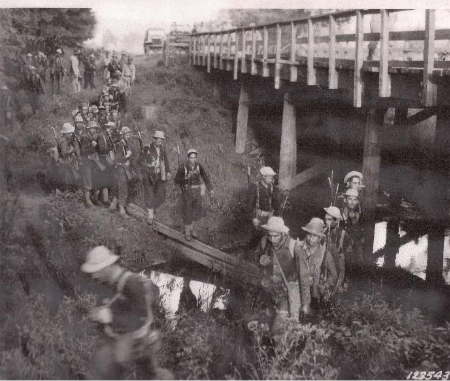
The opening phase of the Louisiana Maneuvers featured Lt. Gen. Ben Lear’s smaller, tank-heavy Red Army attacking Lt. Gen. Walter Krueger’s larger, less armored Blue Army. The implications for European warfare were clear, as smaller German Panzer divisions had frequently trounced larger defending forces. However, this battle occurred in the swamplands of East Texas and Louisiana, instead of the firm grounds of northern France. The maneuvers were staged as a realistic combat simulation, with no stoppages or days off, but also as an elaborate display for the American public showcasing the new army’s readiness to defend the nation. As historians Debi and Irwin Unger put it, “Many of the foot soldiers on maneuvers slogging through the marshes and forests of Louisiana and East Texas, swatting mosquitoes and crushing ticks, were draftees getting their first taste of combat’s rigors.”
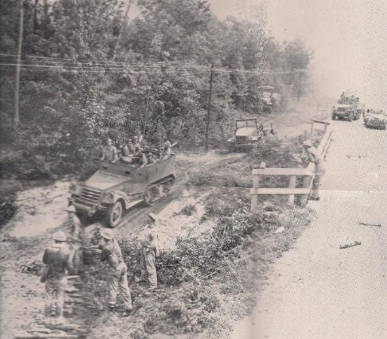
George Patton and his tanks were assigned to Lear’s Red Army, but this was not their battle to shine. The Red Army’s inferior size needed to compensate with speed, flexibility, and shock, none of which were displayed in this fight. Lear was a skeptic of swift armored maneuvers, and as a result, Patton’s tanks were trapped by swamplands, forcing them to move along main paved roads. This situation ultimately made them vulnerable to the Blue Army’s effective dive-bomb attacks.
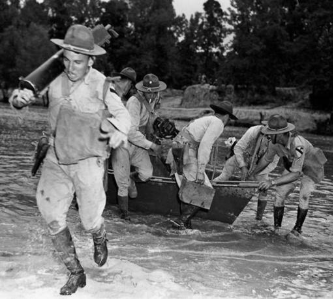
The Blue Army’s 1st Cavalry Division, lurking across the Sabine River in East Texas, clinched the victory by fording an improvised ferry and boldly charging into Louisiana near Zwolle after dark. The charge from the storied Texas cavalrymen put Lear’s Red Army on the ropes. One journalist compared it to the daring cavalry raids of the Civil War. Hours later, the Blue Army’s bombers dropped propaganda leaflets that read, “Rout, disaster, hunger, sleepless nights in the forest and swamps are ahead of you – unless you surrender, surrender while there is still time.”
Patton’s 2nd Armored Division was effectively destroyed in Phase I, bogged down by weather and terrain, and outmaneuvered by infantry and anti-tank units. Patton was disappointed at the battlefield loss and at the missed opportunity to capture his old friend, despite offering his troops a $50 reward to capture “a certain s.o.b. called Eisenhower,” as historian Piers Brendon quoted him saying. Patton’s tankers, eager to redeem themselves and show their tanks’ true speed and power on a larger, more open battle space, lamented, “Wait ‘til the next time.” The final phase of the event provided that open battle space, and Patton’s tanks found their path to victory, moving towards Shreveport through East Texas.
To read the full story, click on Buy Magazines above to purchase a print copy or subscribe.
Click here to read an article by the The National World War II Museum in New Orleans about the Louisiana Maneuvers
Watch this video from the George C. Marshall Foundation about the Louisiana Maneuvers
 Follow