
By Antonio Lopez and Andres Rios
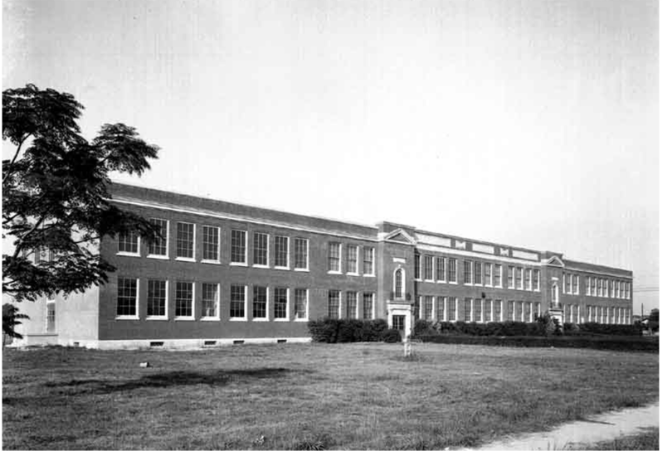
A pillar of the Third Ward community, Jack Yates High School has a rich history that spans a century. Its namesake, Reverend John Henry “Jack” Yates, a formerly enslaved man, rose to prominence in Houston in the late 1860s by promoting community betterment through education and faith. Yates High School’s history reflects a similar story of challenges, resilience, and triumph.i From its founding in 1926, through segregation and beyond, Yates has undergone tremendous change.
Houston’s industrial growth at the turn of the twentieth century offered African Americans a chance to escape the exploitation of sharecropping and other agricultural labor that had contributed to the economic stagnation of the first post-emancipation generation. The city’s Black population increased from 19,894 in 1900 to 33,960 by 1920, with many of them new arrivals seeking economic opportunities. As the number of migrants and their families grew, their children required an education.ii
Houston, like many southern cities, was segregated. Those wielding political power limited opportunities for many African Americans by restricting funding for school buildings, books, and equipment. Thus, few schools fully addressed the students’ needs, even though enrollment at all grade levels steadily rose between 1910 and 1930. In 1910 Houston has 3,565 Black students enrolled, by 1920 the number reached 6,520 and, in 1930, 12,419.iii
Houston schools saw some improvement in the 1920s, including in Black schools. In 1924, Houstonians voted to make their school district independent of city government and subsequently hired a new superintendent, Dr. Edison E. Oberholtzer (1924-1945). In 1925, the district announced plans to build a new high school in the Third Ward for African American students. Two locations were proposed, one on Elgin Street and the other on Dowling Street (now Emancipation Avenue). HISD appropriated $70,000 from a $3 million bond for the construction of the new school; nevertheless, The Informer newspaper argued the funding should be ten times that amount to reflect the size of the Black community. The district then proposed a $4 million bond, allocating $500,000 to build schools and upgrade seventeen others in the Black community.iv This included Jack Yates High School, which opened in 1926, and Phillis Wheatley High School, which opened in Fifth Ward in 1927.
Separate but Equal
The “separate but equal” restrictions legalized by the U.S. Supreme Court in Plessy vs. Ferguson (1896) and Jim Crow laws cemented the divide between the White and Black populations. White schools had better infrastructure and more resources allocated to them, while Black schools were often overcrowded, lacked equipment and books, had inferior facilities, and less funding. The original Yates campus was much smaller compared to White schools like Milby or Reagan (now Heights), built at the same time.v
The original campus lacked sports facilities such as a football field where the team could practice, and Yates played its games in West End Park and Buffalo Stadium, until 1942 when HISD opened Public School Stadium (later renamed Jeppesen and then Robertson Stadium). Separate but equal also affected the curriculum. HISD schools offered its students with college prep courses or vocational training; however, these opportunities were limited in Black schools.vi

Funding and pay differences between Black and White schools and staff were stark. White teachers earned twice as much as Black educators despite having less training. These disparities stemmed from racial bias in state and local funding. Local officials provided minimal resources for Black schools, neglecting the community’s request for equitable facilities. Occasionally, officials built new schools or updated aging facilities in Black neighborhoods, but these efforts were largely ineffective and aimed to appease the community’s loud criticism.vii
Yates High School’s First Twenty-five Years
Jack Yates Senior High School opened its doors on February 8, 1926, becoming Houston’s second high school for African Americans. Opening the school with about 600 students and seventeen teachers, HISD built Yates to alleviate overcrowding at Houston Colored High School in the Fourth Ward. Located at 2610 Elgin, the two-story building had approximately thirty classrooms, a boys’ gymnasium on the first floor and a sewing room and library on the second floor. However, the completed building was smaller than the original plans, which also included a tennis court and a large track field. In 1927, the Houston Informer reported on the first commencement in which one of Jack Yates’s granddaughters presented a portrait of Yates to the school and another sang, in keeping with his legacy.viii
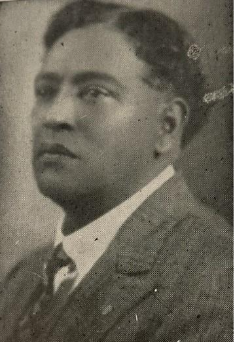
James D. Ryan, a 1890 graduate of Prairie View A&M and an advocate for education, served as Yates’s first principal until his death in 1941. Under Ryan, with the cooperation of Wiley and Prairie View colleges, Yates hosted the first summer school for Black teachers. The school faced funding issues from the start, yet Ryan sought solutions within the Black community rather than confronting White peers, administrators, or city officials about reform. Beloved by his students, “Professor Jimmie” used his own funds to supplement programs, teacher salaries, school supplies, and the salaries of skilled instructors. His dedication helped establish music departments, athletic teams, and foreign language programs such as Latin, Greek, French, and German in Black schools, leading many students to have successful careers in education and the arts. After Ryan’s passing, HISD promoted Yates’s assistant principal William S. Holland to principal, who became an outspoken advocate for the students and school improvements.ix
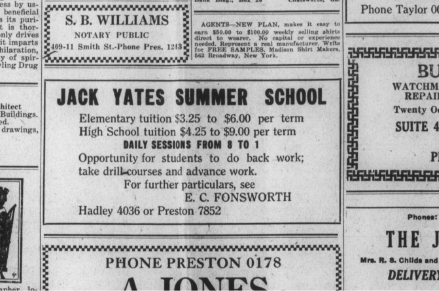
Under Holland, Yates High School continued to offer a wide range of courses, with core classes like reading, writing, math, science, and history, but also vocational training like sewing and cooking for girls, and technical training like welding, construction, plumbing, and auto mechanics for boys. Yates provided summer school classes to elementary and high school students, offering remedial classes, known as “drill courses,” and “advanced work” for a tuition fee. From 1927 to 1947, the campus hosted night classes for the Houston Colored Junior College (1927-1934) and Houston College for Negros (1934-1947), later renamed Texas Southern University.x This early leadership helped to build a stronger community for Houston’s Black families, honoring the school’s namesake, who spent his life trying to lift others through education.
To read the full story, click here.
Click to see how the historic high school celebrated its 100 years of excellence in the community!
 Follow